

Dear My Black Queens: You Will Never Be Small Enough, Quiet Enough, or Perfect Enough...And You Don't Have to Be
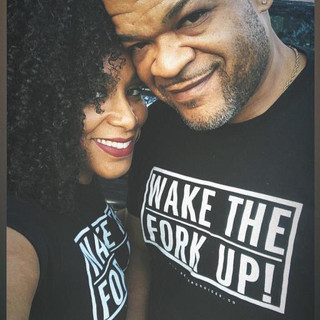
This week's news reminded us of a truth many of us already carry in our bodies. This is not a body-image post. It's a letter about why the fight was never about your body to begin with.

Dear My Black Queens,
We need to talk about something that has nothing to do with food, and everything to do with why so many of us have a complicated relationship with it.
This week, a UFC fighter stood on the South Lawn of the White House, fresh off a win, and used his moment in front of millions to falsely declare that Michelle Obama, a Princeton and Harvard Law graduate, a former First Lady of the United States, one of the most accomplished and admired women in the world, “is a man.” It wasn't the first time. He said the same thing about WNBA champion Brittney Griner a few months earlier. The UFC's own CEO called it nasty, false, and nonsense. The White House had nothing to say at all.
We are not writing today to relitigate the news cycle. We are writing because of what that moment confirmed for so many of us, again: no amount of success, education, grace, beauty, or accomplishment protects a Black woman from being dehumanized in public.
Michelle Obama did everything we are taught will make us acceptable. She excelled academically. She built an extraordinary career before she ever stepped into the White House. She was composed, gracious, dignified, reportedly even strategic about which battles to engage and which to let pass, for the sake of optics, for the sake of her family, for the sake of not giving anyone an excuse. And it did not matter. It has never mattered. Because the attack was never actually about her conduct. It was about her existence.
This Is Not New. It's Generational.
Black women have been shrinking ourselves for everyone else for centuries.
Shrinking our voices so we wouldn't seem intimidating. Shrinking our needs so we wouldn't seem demanding. Shrinking our bodies so we could fit standards we never created. Shrinking our anger, our joy, our ambition, our softness, calibrating every part of ourselves against an audience that was never going to be satisfied no matter how precisely we measured the dose.
And somehow, no matter how much we shrink, it is never enough.
This pattern has a name in research: gendered racism, or what some scholars also describe as misogynoir, the unique, compounded form of discrimination that exists at the intersection of being Black and being a woman, distinct from racism alone or sexism alone. Black women experience this intersection as its own category of stressor, one that cannot be fully explained by race or gender in isolation (Perry, Harp, & Oser, 2013).
Researchers have also documented something specific about how Black women in leadership and public life are perceived: we are stereotyped as inherently dominant and strong, in ways white women are not, which means we face a particular kind of backlash when we are simply existing in positions of visibility, competence, or power (Rosette, Koval, Ma, & Livingston, 2016).
We are expected to be strong. And then we are punished for the very strength we were required to display. That contradiction is not an accident. It is the mechanism.
No Matter How Hard We Try to Assimilate
There is a particular kind of grief in realizing that the rules were never really rules. We were told: get the degree, and you'll be respected. Get the career, and you'll be taken seriously. Speak softly, dress appropriately, smile through it, give people the benefit of the doubt, don't make anyone uncomfortable and you'll finally be safe from the thing you've always sensed was coming for you.
We did that. Many of us have spent our entire lives doing that. And the truth this week confirmed, the truth that has been confirmed over and over across generations, is this: no matter how successful we become, no matter how nice we are, no matter how much we assimilate to the foot on our neck, we will never be fully seen, fully respected, fully treated as equal, or fully accepted by a system that was never built to do those things for us in the first place.
We want to say that plainly, because softening it doesn't serve you. This is not a call to stop striving, stop achieving, or stop becoming everything you are capable of becoming. It is a call to stop expecting that striving to be the thing that finally earns you safety from people who were never going to give it to you regardless of what you did. Your worth cannot be a transaction you complete well enough to finally be granted humanity. It was never up for negotiation to begin with.
Why This Lives in the Body
This is a health blog, and we want to be honest about why this matters here specifically.
The relationship many of us have with food, weight, and body image did not start with a diet. It started with generations of messages, some spoken, most absorbed, telling us to be smaller, quieter, less visible, more acceptable. That conditioning doesn't stay abstract. It lives in the body as chronic stress, and chronic stress has measurable, well-documented physiological consequences.
Black women navigating this compounded racial and gender discrimination experience it as a distinct and significant stressor, one connected to depression, anxiety, and broader indicators of psychological distress, independent of other life stressors (Perry, Harp, & Oser, 2013; Stevens-Watkins, Perry, Pullen, Jewell, & Oser, 2014). This is not metaphorical. It is measured.
Much of this gets absorbed through what researchers call the Strong Black Woman schema, the cultural expectation that Black women must be unrelentingly resilient, self-sufficient, and emotionally composed, regardless of what we are carrying. The schema can offer real psychological benefits: a sense of agency, resistance, and self-efficacy in the face of oppression (Woods-Giscombé, 2010). But internalizing it too completely, silencing our own needs to maintain the appearance of strength, is consistently linked to higher rates of depression and anxiety (Liao, Wei, & Yin, 2020).
This is why we have always said, in every coaching session and every program we've built: this is not a willpower problem. It's a history problem with a personal address. You cannot discipline your way out of a nervous system that has been taught, for generations, that your body and your presence are subject to public commentary.
What Healing Actually Requires
Healing isn't just about calories, macros, or willpower. It's about rejecting the belief that our value is tied to our appearance, our composure, or our ability to make everyone else comfortable. Here is what we want you to carry forward:
1. Your body is not public property.
It does not exist for commentary, comparison, or approval. Not from a stranger on a stage, not from family, not from the version of yourself that learned to critique before anyone else could.
2. Health is not the same as shrinking.
The goal of any real health journey is not to take up less space. It's to live fully in the space you already deserve with the energy, strength, and stability to actually inhabit your life.
3. We do not owe anyone smaller versions of ourselves.
Not physically. Not emotionally. Not professionally. The people who require your shrinking in order to be comfortable were never entitled to your comfort at the cost of your own.
4. Healing requires telling the truth.
Some of the battles we've fought with our bodies were inherited long before they ever became personal. Naming that is not an excuse. It is the first accurate diagnosis.
5. Taking care of yourself is an act of resistance.
Every nourishing meal, every boundary, every movement you choose because it feels good rather than because it makes you smaller, every one of those choices says: I deserve care, too.
In a world that has rarely volunteered that care to us, choosing it for ourselves is not indulgence. It is defiance.
Remember, healing begins when we stop asking our bodies to become smaller than the life we're meant to live.
We see you. We are you. Much love to you Black Queen.
References
Liao, K. Y.-H., Wei, M., & Yin, M. (2020). The misunderstood schema of the strong Black woman: Exploring its mental health consequences and coping responses among African American women. Psychology of Women Quarterly, 44(1), 84–104. https://doi.org/10.1177/0361684319883198
Perry, B. L., Harp, K. L., & Oser, C. B. (2013). Racial and gender discrimination in the stress process: Implications for African American women's health and well-being. Sociological Perspectives, 56(1), 25–48. https://doi.org/10.1525/sop.2012.56.1.25
Rosette, A. S., Koval, C. Z., Ma, A., & Livingston, R. (2016). Race matters for women leaders: Intersectional effects on agentic deficiencies and penalties. The Leadership Quarterly, 27(3), 429–445. https://doi.org/10.1016/j.leaqua.2016.01.008
Stevens-Watkins, D., Perry, B., Pullen, E., Jewell, J., & Oser, C. B. (2014). Examining the associations of racism, sexism, and stressful life events on psychological distress among African-American women. Cultural Diversity and Ethnic Minority Psychology, 20(4), 561–569. https://doi.org/10.1037/a0036700
Woods-Giscombé, C. L. (2010). Superwoman schema: African American women's views on stress, strength, and health. Qualitative Health Research, 20(5), 668–683. https://doi.org/10.1177/1049732310361892


Comments